
Yellow and blue are two of the most striking and widely worn colour combinations in world football.
Whether drawn from national flags, city coats of arms, or legendary club folklore, the yellow and blue kit has become one of the most recognisable colour schemes in the sport.
Here are 20 of the most popular soccer teams that play in yellow and blue, covering national teams and football clubs from across the globe.
You might also enjoy reading about the soccer teams that play in yellow and the football teams that play in blue.
1. Sweden
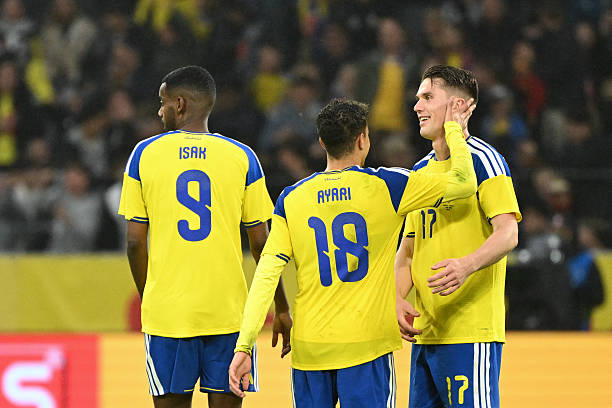
Sweden are the most iconic yellow and blue national team in world football.
Their home kit is a yellow shirt with blue shorts and yellow socks, taken directly from their national flag, which features a blue background with a golden-yellow Scandinavian cross.
The colours have been worn since Sweden first played internationally in 1908, making them one of the longest-running and most consistent kit colour schemes in the history of the game.
For away fixtures the combination is reversed to a blue shirt, yellow shorts, and blue socks.
The 2026 Adidas home kit draws inspiration from Sweden’s 1970s cultural aesthetic, featuring tone-on-tone graphics woven into the fabric referencing floral embroidery from traditional Swedish folk costumes.
Sweden finished second at the 1958 World Cup and third in both 1950 and 1994, wearing the yellow and blue colours throughout their greatest moments.
Alexander Isak and Viktor Gyokeres are the current standard-bearers of the famous yellow shirt at club level.
2. Brazil
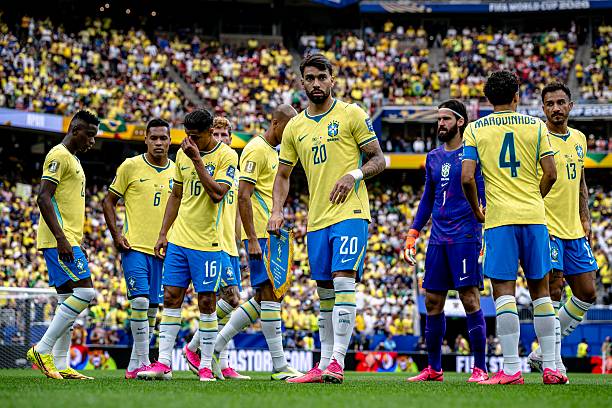
Brazil are the most famous yellow and blue football nation in the world, though their story began in tragedy.
Before 1954, Brazil played in an all-white kit, which was widely criticised for lacking patriotism after their devastating 2-1 defeat to Uruguay in the 1950 World Cup final on home soil, a game known as the Maracanazo.
Following the defeat, the newspaper Correio da Manha launched a competition to design a new kit using all four colours of the Brazilian flag: yellow, green, blue and white.
The winning design came from a 19-year-old illustrator named Aldyr Garcia Schlee, who drew a yellow shirt with green trim and blue shorts, a combination Brazil have worn ever since.
The kit made its debut on 14 March 1954 in a match against Chile, and Brazil went on to win five World Cups wearing it.
In an ironic footnote, when Brazil reached the 1958 World Cup final against hosts Sweden, who also wore yellow, Brazil had no change strip and officials purchased blue shirts and stitched on the national badge, connecting both their yellow and blue identities on the same night.
The yellow jersey earned the team its famous nickname Canarinho, the little canary, and is one of the best soccer jerseys of all time.
3. Ukraine
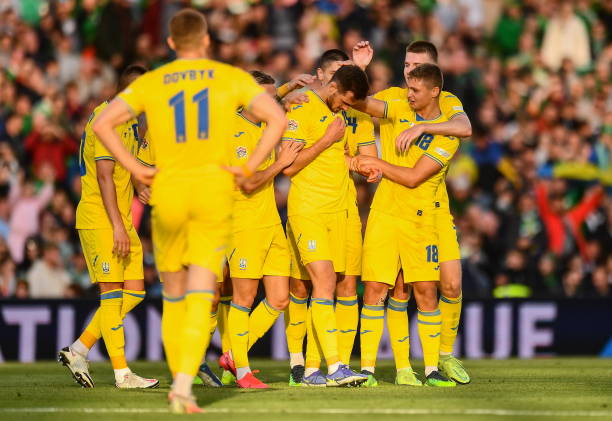
Ukraine play in yellow and blue, the two colours of their national flag, which represents golden wheat fields under a blue sky.
The national team played their first ever match on 29 April 1992 against Hungary, shortly after the country gained independence from the Soviet Union, wearing an Umbro-made yellow home kit.
The all-yellow home kit variant first debuted in 1996 during Euro qualification and has been the standard home look ever since, with blue shorts completing the flag colour scheme.
In October 2024, Ukraine officially returned to Adidas as their kit supplier after seven years with Spanish brand Joma, launching a new yellow home kit first worn during the UEFA Nations League.
Ukraine’s finest hour in the yellow and blue came at the 2006 FIFA World Cup, where Andriy Shevchenko led the team to the quarter-finals on their tournament debut.
Despite the devastating ongoing war in their country, Ukraine’s national team continues to compete with enormous pride in their yellow and blue colours.
4. Colombia

Colombia‘s yellow home jersey is one of the most vibrant and beloved kits in international football, though it was not always the case.
Colombia’s first shirt in 1938 was sky blue, and through the following decades they wore dark blue, orange, and red home jerseys at various points.
Yellow did not appear on a Colombia kit until the 1980s, when it was used as an away option, and it was not until 1993, when they partnered with English brand Umbro, that the yellow jersey became the official home kit.
The traditional home colours are now a yellow shirt with navy trim paired with navy or white shorts, taken from the Colombian national flag.
The yellow jersey was cemented in world football’s consciousness at the 2014 World Cup, where James Rodriguez’s golden boot performances made Colombia’s kit one of the most purchased international shirts of that tournament.
Colombia qualified for the 2026 World Cup and are one of the most exciting South American football nations in the world today.
5. Ecuador

Ecuador play in a bright yellow home jersey with blue collar and blue sleeve detailing, taken from the colours of the Ecuadorian national flag.
Their flag, like Colombia’s and Venezuela’s, derives from the Gran Colombia tricolour of yellow, blue and red, which explains the shared colour scheme across several South American national teams.
Ecuador have worn yellow as their home colour throughout their international history and their 2026 World Cup kit features a bright yellow base with navy and red detailing, worn as they appeared on the global stage in North America for the third time.
Their most memorable World Cup moments came in 2006 in Germany, where they reached the round of 16 wearing their distinctive yellow and blue colours.
6. Romania
Romania have worn a yellow home jersey for the vast majority of their international history, one of the most recognisable yellow kits in European football.
The yellow is taken from the Romanian national flag, which features three vertical bands of blue, yellow and red.
Romania’s 2025/26 Joma home kit was inspired directly by their iconic 1994 World Cup jersey, which is considered by fans to be the finest Romania kit ever made, worn during their memorable run to the quarter-finals where they defeated Argentina.
Adidas supplied Romania’s kits from 1984 to 2015, during which time Gheorghe Hagi lit up the world stage and the golden yellow jersey became synonymous with one of Eastern Europe’s greatest footballing generations.
The 2025/26 kit was launched under the campaign slogan “The jersey that makes us visible,” with Romanian designer Jean Popescu collaborating to honour the national team’s heritage.
7. Bosnia and Herzegovina
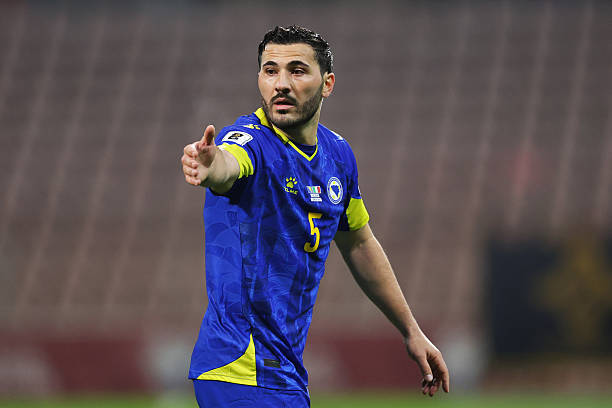
Bosnia and Herzegovina play in a blue home jersey with gold detailing, the two primary colours of the Bosnian national flag.
The flag features a blue background with a yellow triangle and white stars, and the national team’s blue and gold kit has reflected those colours since the country first played internationally in 1995 following the end of the Bosnian War.
Bosnia qualified for their first ever FIFA World Cup in 2014 in Brazil and reached the group stage wearing their blue and gold away colours in a famous victory over Iran.
The blue and gold jersey represents a young football nation with deep passion and significant talent, with players like Edin Dzeko having worn it with great distinction.
8. Kazakhstan
Kazakhstan play in a light blue home jersey with yellow detailing, the two colours of their national flag, which shows a golden sun and eagle over a sky blue background.
The Kazakhstani national team compete in UEFA despite being geographically in Central Asia, having switched from the AFC to UEFA in 2002.
Their blue and yellow kit reflects the enormous sky and steppe landscape of their vast Central Asian nation, and the team has grown steadily in European football competition, recording notable results in UEFA Nations League campaigns.
9. Gabon
Gabon play in a yellow home jersey with blue shorts, taken from the Gabonese national flag which features three horizontal bands of green, yellow and blue.
Their yellow and blue home kit became globally recognised during the era of Pierre-Emerick Aubameyang, who wore it as one of the most prolific strikers in world football during his peak years at Borussia Dortmund and Arsenal.
Gabon have qualified for the Africa Cup of Nations on multiple occasions and are one of the most recognisable yellow and blue national teams on the African continent.
10. Boca Juniors
Boca Juniors have one of the most famous and most romantically explained yellow and blue kits in the entire history of world football.
In 1906, Boca played against Nottingham de Almagro and both teams wore the same colours, so it was decided that whoever lost the match would have to change their kit.
Boca lost and headed to the port of La Boca to choose new colours, deciding they would adopt the flag of the first ship that sailed into the port.
A Swedish ship docked that day, and so Boca adopted the blue and yellow of the Swedish flag, a kit combination that has since become one of the most recognisable in world football.
Their home kit features an all-blue shirt with a distinctive yellow horizontal band across the chest, worn at La Bombonera in Buenos Aires in front of one of the most passionate fanbases on the planet.
Boca are one of the most successful clubs in South American history, having won the Copa Libertadores six times.
11. Fenerbahce

Fenerbahce are Turkey’s most famous yellow and blue football club, wearing a home kit of yellow and navy blue vertical stripes that is one of the most recognisable in European football.
The kit was designed by winger Hikmet Topuzer and the yellow and navy blue colour scheme was inspired by the lighthouse within the city district of Fenerbahce and the yellow daffodils found in the area.
The crest was originally yellow and white at the club’s founding, but founder Ziya Songulen changed it to yellow and navy blue, the combination that has defined the club ever since.
Fenerbahce have won 28 Turkish Super Lig titles and are one of the most supported clubs in the country, regularly attracting some of the highest-paid players in the Turkish league.
12. Mamelodi Sundowns

Mamelodi Sundowns are the most successful club in South African football history and play in a striking yellow and blue home kit.
Their yellow shirt and blue shorts combination is similar to Brazil’s, which is one reason the club earned the nickname “The Brazilians,” a tag they have proudly carried throughout their history.
Founded in 1970 in Mamelodi, Pretoria, Sundowns are one of the richest football clubs in South Africa and have worn their yellow and blue colours throughout their rise to become the dominant force in South African and African club football.
They won the CAF Champions League in 2016 and have claimed over 10 DStv Premiership titles, making their yellow and blue jersey synonymous with silverware in African football.
13. Cádiz CF

Cadiz CF are one of La Liga’s most distinctive yellow and blue clubs, nicknamed El Submarino Amarillo (The Yellow Submarine).
Their home kit is a yellow shirt paired with blue shorts, a combination that has been associated with the club since the 1950s when the yellow was chosen to reflect the sunny climate of Andalusia and stand out from Spain’s predominantly red and white clubs.
The blue shorts complete the colour scheme of the Cadiz city flag, making the kit a direct expression of local civic identity.
The club is based in the historic port city of Cadiz in southern Spain, one of the oldest continuously inhabited cities in Western Europe, and the yellow and blue kit reflects the proud, distinct identity of that community.
14. Parma Calcio
Parma Calcio are one of Italian football’s most storied clubs, and yellow and blue have been their identity since the club’s founding in 1913.
The decision to wear yellow and blue was taken to honour the traditional colours of the city of Parma, which appear on the city’s coat of arms dating back to 1545 when the Duchy of Parma was founded.
The club’s traditional home kit featured yellow and blue hoops with blue shorts and yellow socks, and those colours remain central to their identity today as their away kit, while the current home features a white base with a black cross.
Parma enjoyed their greatest era in the 1990s under Nevio Scala and then Carlo Ancelotti, winning the UEFA Cup twice, the Copa Italia, and the UEFA Super Cup while wearing the yellow and blue combination that made them one of Europe’s most glamorous clubs.
15. NAC Breda
NAC Breda are one of the most recognisable yellow and blue clubs in Dutch football, based in the city of Breda in the south of the Netherlands.
Their home kit has traditionally featured yellow as the dominant colour with blue detailing, a colour scheme that has defined the club throughout their history in the Eredivisie.
Their 2025/26 home kit was supplied by Nike, continuing the tradition of yellow as their primary home colour, while their away kit for the season was designed in collaboration with DJ Tiesto, a famous son of Breda, bringing the club international attention.
They are one of the most culturally connected clubs in Dutch football, with a strong local identity rooted in the proud city of Breda.
16. Central Coast Mariners
Central Coast Mariners are one of Australia’s most recognisable yellow and blue football clubs, competing in the A-League.
The club’s official colours are navy blue and yellow, a combination they have worn throughout their history since being founded as one of the original A-League clubs in 2004.
Their 2025/26 home kit features a predominantly yellow shirt with navy detailing, a design that drew mixed reactions from supporters but maintained the club’s traditional colour identity.
The Mariners have won the A-League championship twice and are one of the most passionate football communities on Australia’s Central Coast.
17. Hellas Verona
Hellas Verona are one of Serie A’s most distinctive yellow and blue clubs, nicknamed I Gialloblu, which translates directly as The Yellow-Blues.
Founded in 1903, the club have worn yellow and blue vertical stripes as their home kit throughout their history, with yellow as the dominant colour.
The colours are associated with the city of Verona and the club’s crest, which bears the image of Cangrande I della Scala, the medieval lord of Verona.
Hellas Verona achieved their greatest moment in the 1984/85 season when they won the Serie A title, a stunning achievement that remains one of the most celebrated upsets in Italian football history.
They share the yellow and blue identity with city rivals Chievo Verona, creating one of the most unusual local derbies in world football where both teams wear the same primary colours.
18. Chievo Verona
Chievo Verona are the second yellow and blue club from the city of Verona, also nicknamed I Gialloblu like their city rivals Hellas.
Founded in 1929 in the small Chievo district of Verona, the club traditionally wore an all-yellow jersey with blue strips on the sleeves, with their crest also bearing the image of Cangrande I della Scala.
Chievo’s most remarkable achievement was their rise from Italian amateur football to Serie A, where they became known as the Flying Donkeys and proved themselves competitive against Italy’s biggest clubs.
The club has been refounded twice due to financial difficulties and currently competes in Italian Serie D, but their yellow and blue identity remains one of the most distinctive in Italian football.
19. Modena FC
Modena FC are one of Italian football’s most recognisable yellow and blue clubs, based in the Emilia-Romagna region of northern Italy.
Their home kit features a traditional yellow base with a bold blue diagonal stripe across the chest, a design that incorporates the club’s emblem, the canary, at heart level.
The yellow and blue are drawn from the traditional colours of the city of Modena, reflecting the same civic pride in local heraldry that defines kit colours throughout Italian football.
The Canarini, as they are nicknamed in honour of the canary, have competed at various levels of Italian football and their distinctive diagonal-stripe kit is one of the most original designs in Serie B.
20. BATE Borisov
BATE Borisov are the most successful football club in Belarusian history and play in a yellow and blue home kit that reflects their national footballing dominance.
The club are nicknamed Zholto-Sinie, which translates directly as Yellow-Blues, making their yellow and blue identity as central to their name as their footballing record.
BATE have dominated Belarusian football, winning the domestic league, cup and super cup on multiple occasions, and are the only Belarusian club to have qualified for the group stages of the UEFA Champions League.
Their yellow and blue home jersey has been seen on European football’s biggest stage, representing one of Eastern Europe’s most historically consistent clubs.
OTHER POPULAR SOCCER TEAMS AND NATIONAL TEAMS THAT PLAY IN YELLOW AND BLUE:
- Tigres UANL (Mexico)
- Al Nassr (Saudi Arabia)
- Torquay United (England)
- Oxford United (England)
- Shrewsbury Town (England)
- FC Den Bosch (Netherlands)
- Roda JC (Netherlands)
- Elfsborg (Sweden)
- Brondby IF (Denmark)
- Moldova national team
- Andorra national team
- Solomon Islands national team
- Tuvalu national team
- Chad national team
You might also be interested in reading about the soccer teams sponsored by Nike and the soccer teams sponsored by Adidas.
Which yellow and blue soccer team is your favourite? Let us know in the comments below!