
Green is one of the most widely worn colours in world football, carried by countries and clubs on every continent.
For some of these teams the colour was there from day one, while others arrived at green only after a change of heart, a merger, or a flag redesign decades later.
Worn by some of the world’s most historic clubs and successful national teams, green kits are instantly recognizable and often carry deep cultural, regional, or national significance.
Let us find out the European giants to African powerhouses and iconic international sides, basically the best soccer national teams and clubs famous for wearing green jerseys.
Here is a rundown of the most notable national teams and football clubs that play in green, along with the story behind how each of them got there.
You might also enjoy reading about the soccer teams that play in yellow and the football teams that play in black jerseys.
1. Nigeria
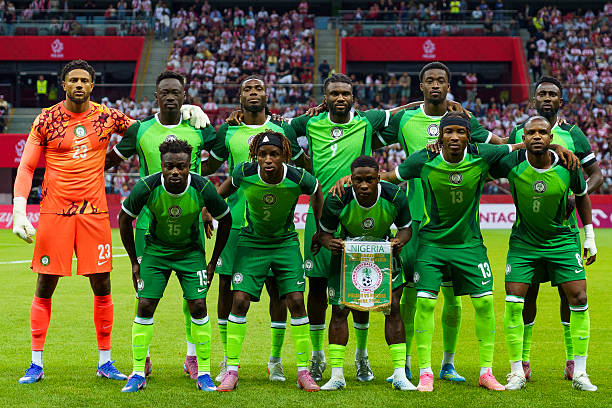
The Super Eagles take their green directly from the national flag, where the colour represents the country’s natural wealth and agriculture.
The team was known as the Green Eagles until a rebrand in the 1990s gave the side its current nickname.
Nigeria have won the Africa Cup of Nations three times, though they did not qualify for the 2026 World Cup.
The green shirt remains one of the most recognisable kits to come out of African football, regardless of the manufacturer behind it in any given year.
2. Mexico

Green has been El Tri’s calling card for generations, long before it became one of the most recognisable national kits in the sport.
Their 2026 Adidas home shirt keeps that green base and layers a large Aztec sunstone graphic across the front.
Mexico do not need to qualify for the 2026 FIFA World Cup, since they co-host the tournament alongside the United States and Canada.
Hugo Sanchez, one of the great strikers of his generation, wore that same green for club and country decades before the current squad did.
3. Celtic

Celtic were founded in Glasgow in 1887 by Brother Walfrid, a move meant to raise money for the city’s poor Irish immigrant community.
Green was written into the club from the very first match, chosen as a nod to that Irish heritage, though the famous hoops did not appear until 1903.
Before the hoops, Celtic had briefly worn green and white vertical stripes, so the design fans know today is actually the club’s third kit concept in under twenty years.
Celtic remain one of only a handful of clubs anywhere to pass 100 major trophies, a tally that puts them among the most decorated names in the sport.
4. Republic of Ireland
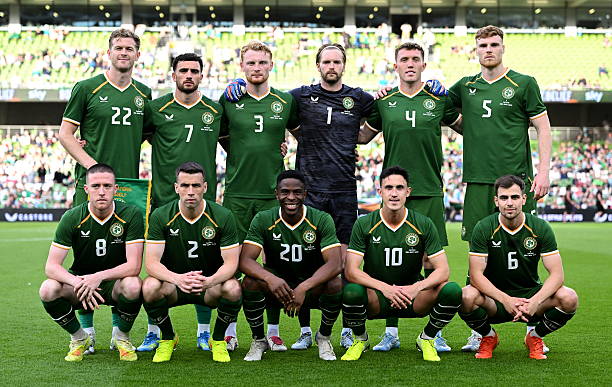
The Boys in Green have carried that nickname since the earliest days of the national team, when green shirts, white shorts, and green socks became the standard kit.
Ireland’s 2025-26 Castore home kit keeps that same deep green with white and orange trim taken from the national flag.
The team came close to reaching the 2026 World Cup, only to fall on penalties to Czechia in the play-off semi-final in March 2026.
Ireland’s most cherished era remains the Jack Charlton years of the late 1980s and early 1990s, which included a World Cup quarter-final run in 1990.
5. Saudi Arabia

Saudi Arabia’s green home kit is newer than it looks.
The national team traditionally wore white with green trim at home and green with white trim away, only swapping the two around in 2023 to make green the primary colour.
The 2026 Adidas home kit keeps that dark green base and adds purple and gold detailing inspired by the palm tree on the national emblem.
Saudi Arabia have qualified for the 2026 FIFA World Cup, their third consecutive appearance at the tournament.
6. Cameroon
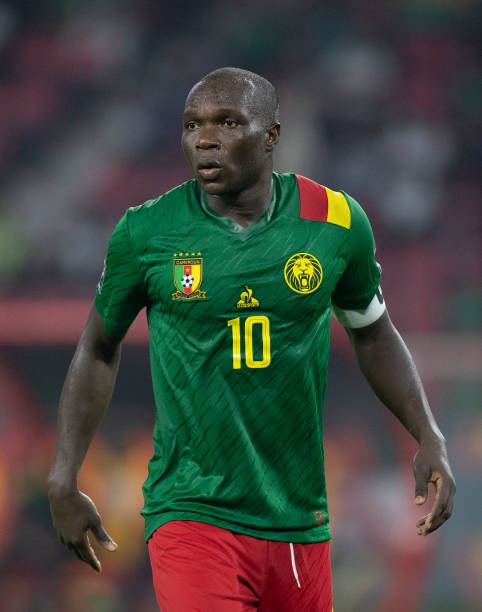
The Indomitable Lions have worn green since it was adopted as a national colour, drawn straight from Cameroon’s flag.
Their 2025-26 kit keeps that green base with red and yellow accents completing the tricolour.
Cameroon made history in 1990 by becoming the first African side to reach a World Cup quarter-final, with Roger Milla’s celebrations at the corner flag still replayed to this day.
Samuel Eto’o later became the green shirt’s most decorated wearer, winning the Africa Cup of Nations twice.
7. Palmeiras

Palmeiras were founded by Italian immigrants in Sao Paulo, and the club’s original name, Palestra Italia, reflected that background before a wartime name change during the Second World War.
Green survived that transition and remains the reason supporters call the club Verdao, or Big Green.
The 2025 Puma home kit carries a jacquard pattern referencing the club’s Brazilian championship history, with 12 stars marking each of their league titles.
Palmeiras’ 12 Brazilian championships make them one of the most decorated clubs on the continent.
8. Real Betis

Real Betis adopted their green and white stripes in 1914, and the story behind it runs straight through Scotland.
One of the club’s founders had seen Celtic play and brought the idea of green and white home to Seville, where it was also read as a tribute to the flag of Andalusia.
The 2025-26 Hummel home kit brings the stripes back wider than in recent seasons, with green dominating the rear of the shirt for the first time in years.
The club’s fans, known as the Beticos, are considered some of the most loyal in Spanish football despite Betis rarely challenging for the biggest honours.
9. Sporting Lisbon

Sporting’s green and white hoops are one of the oldest identities in Portuguese football, dating back to the club’s founding in 1906.
For the 2024-25 season the club broke from tradition with a tricolour striped shirt, only to reverse course for 2025-26 and bring the hoops straight back by popular demand.
This is the first time in several years the hoops have also run across the sleeves.
Sporting remain one of Portugal’s big three clubs, alongside rivals Benfica and Porto.
10. Panathinaikos
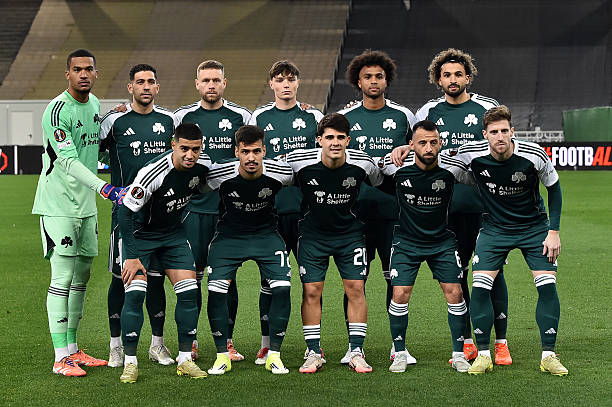
Green was not actually the first colour Panathinaikos wore.
The club, founded in Athens in 1908, originally played in red and white before switching to green and white a couple of seasons later.
Their shamrock crest followed in 1918, chosen by a club member as a symbol of unity and good luck, and it is still the reason supporters call the club Trifylli, meaning clover.
The 2025-26 Adidas home kit strips things back to a simple, solid green shirt with that same white clover embroidered on the chest.
11. Ferencvaros

Ferencvaros, known to fans as Fradi, have carried green and white since the club’s founding in 1899 in the Ferencvaros district of Budapest.
The 2025-26 Macron home kit returns to horizontal stripes, a look last seen between 2017 and 2019, after several seasons of vertical designs.
A line from the club anthem, “Green eagles, fly high,” is stitched inside the collar of the new shirt.
Ferencvaros are the reigning Hungarian champions and remain the most decorated club in the country’s history.
12. AS Saint-Etienne

The nickname Les Verts, meaning The Greens, comes directly from the shirt Saint-Etienne have worn throughout their history.
The 2025-26 Hummel home kit keeps that green base with white sleeves, designed with the local Cite du Design to celebrate the city’s industrial heritage.
Saint-Etienne currently play in Ligue 2 following relegation, a step down for a club that still holds a record 10 French league titles.
Michel Platini wore the green shirt before becoming one of the finest midfielders in the history of the sport.
13. Werder Bremen
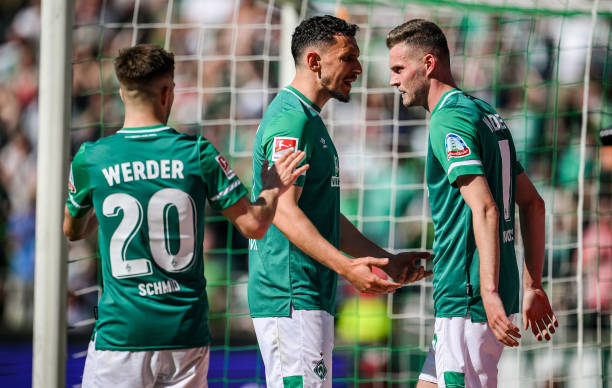
Werder Bremen’s story starts with a tug of war, not a football match.
A group of sixteen-year-old students in Bremen won a football as a prize in a tug of war contest in 1898 and used it to found the club the following year, naming it after the Werder, a stretch of land by the river where they played.
Green and white were the club’s colours from that very first season and have never changed since.
Their 2025-26 Hummel home kit is inspired by Bremen’s tram lines, worked into the design as white pinstripes running down a slightly darker shade of Werder green.
14. VfL Wolfsburg

Wolfsburg is a young club by German standards, founded in 1945 in a city built around the Volkswagen car factory, and green has been part of its identity from the start.
The 2025-26 Nike home kit fades from a deep forest green at the shoulders into a bright neon shade at the hem, marking the return of dark green for the first time since 2019-20.
Volkswagen’s logo has been part of the club’s shirt sponsorship for decades, tying the team directly to the city’s industrial identity.
Wolfsburg won their only Bundesliga title in 2009 under manager Felix Magath.
15. Hibernian
Long before Celtic existed, Hibernian were doing the same thing in Edinburgh.
The club was founded in 1875 by Irish Catholic immigrants in the city’s Cowgate district, and green was adopted immediately as one of the symbols of that heritage, alongside the name Hibernian itself, taken from the Latin word for Ireland.
Their 2025-26 Joma home kit, a deep green body with white sleeves, was launched to mark the club’s 150th anniversary season.
Hibernian’s colours are effectively as old as organised football in Scotland, predating their more famous Glasgow counterpart by a dozen years.
16. Shamrock Rovers

Ireland’s most successful club takes its name from the country’s national emblem, and the green and white hoops on their shirt reflect that identity just as directly.
The 2025-26 season kit stays true to the traditional hoops, finished with a white knitted polo collar edged in thin green lines.
Shamrock Rovers play their home matches at Tallaght Stadium in Dublin.
The club has won more League of Ireland titles than any other side in the competition’s history.
17. Atletico Nacional
Atletico Nacional’s nickname, Verdolaga, refers to a green weed that grows wild across Colombia, a slightly unglamorous origin for one of the country’s most successful clubs.
Their 2025-26 home kit keeps the traditional green and white vertical stripes the club has worn for decades.
Atletico Nacional have won the Copa Libertadores twice, in 1989 and 2016, making them one of only a few Colombian clubs to lift South America’s top club prize.
The club is based in Medellin and remains a fierce rival of Independiente Medellin in the city’s biggest derby.
18. Club Leon
Mexican side Club Leon have gone by three different green nicknames since their founding in 1944, including La Fiera, Los Esmeraldas, and Los Panzas Verdes.
Green has remained the club’s signature colour for more than eighty years, longer than most clubs in Liga MX have existed at all.
The 2025-26 Charly home kit keeps that green with subtle tonal patterns and gold detailing on the collar.
Club Leon have won eight Liga MX titles, making them one of the most successful clubs in the league’s history.
19. Bolivia
La Verde, meaning The Green, is more than a nickname for the Bolivian national team, it describes the identity of a side that plays its home matches nearly 3,637 metres above sea level in La Paz.
Their 2025 Marathon Sports kit is a deep forest green, released to mark the football federation’s 100th anniversary.
That altitude has long been considered one of South American football’s great home advantages, unsettling visiting teams unused to the thin air.
Bolivia’s high point remains winning the 1994 Copa America on home soil.
20. FC Groningen
FC Groningen’s stadium, the Euroborg, carries the nickname the Green Cathedral, a reflection of just how tied to green this Dutch club is.
The 2025-26 Robey home kit brings back shortened green stripes as a tribute to the shirts the club wore during its final seasons at the old Oosterpark ground.
The design also marks 20 years since Groningen’s move to their current home.
Groningen have remained a fixture of Dutch top-flight football for most of their history since forming in 1971.
A note on other green sides
Green shows up as an accent on several other well-known teams, including Senegal and Algeria, but both nations currently play in kits that are white or beige-based rather than green, so they were left off this list to keep things accurate.