
Why Yellow Cards Matter in Modern Football
Football has always been a game full of passion, where emotions move as fast as the players. One moment, a team is launching a perfect attack, the crowd is roaring, and everything feels under control. Then, a whistle blows, the referee reaches into his pocket, and out comes the yellow card. Suddenly, the match changes its pace.
In football games today, the yellow card is not just a formality — it is a turning point, a warning shot, a psychological signal. It tells a player, “Careful now. The next step could be your last.”
Modern football is faster, tougher, and more intense than ever. Tactical fouls, time-wasting, and heated arguments are all part of the drama. The yellow card plays a key role, balancing discipline and excitement. It protects players, keeps order, and reminds everyone that football, despite its beauty, must follow rules.
That is why understanding yellow card soccer is not only useful for players, but also for fans who want to truly read the match beyond the scoreline.
What Is a Yellow Card in Soccer?
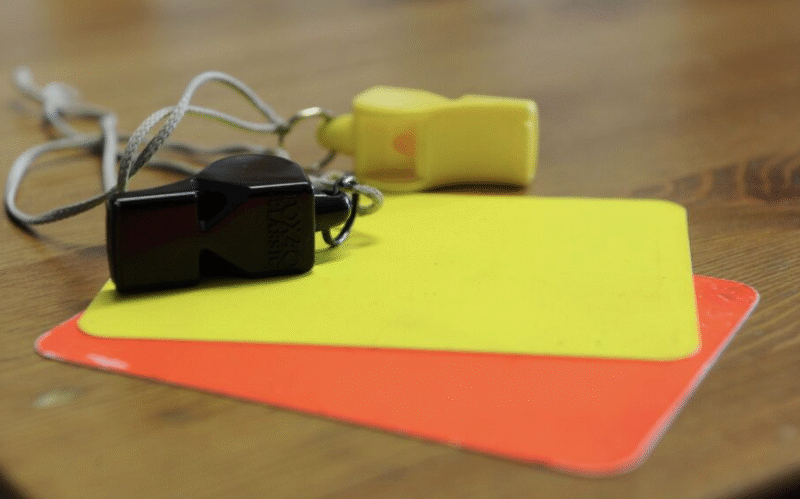
So, what’s a yellow card in soccer? In the simplest terms, it is an official caution shown by the referee when a player breaks the rules or behaves in an unsporting way.
Think of it like a traffic light: yellow means slow down, think twice, and proceed with care. A player who gets a yellow card isn’t removed from the game, but the message is clear: the referee is watching.
Unlike a red card, which ends a player’s participation immediately, a yellow card allows the match to continue while drawing a line in the sand. It is football’s way of saying:
“This is your warning. Don’t push your luck.”
The beauty of this system is its universality. No matter the language, no matter the stadium, everyone understands what a raised yellow card means.
Yellow Card Meaning in Soccer: Official Purpose
To answer properly what a yellow card means in soccer, we must look beyond the surface. Officially, a yellow card is recorded as a disciplinary action. It becomes part of the match report, part of the player’s history, and sometimes part of a larger tournament storyline.
A single caution may not send you off the pitch, but it changes everything around you. The referee will pay closer attention. Opponents may try to provoke another foul. Coaches may even adjust tactics to protect a booked defender.
Its role is both practical and psychological:
- It maintains control of the match.
- It discourages reckless play.
- It protects the spirit of fair competition.
And perhaps most importantly, it reminds us that football is not chaos — it is controlled passion.
Common Reasons Players Receive a Yellow Card
Yellow cards are shown for many types of offenses, usually when a player crosses the boundary of acceptable behaviour. Referees consider not only the foul itself, but also the intention, the danger, and whether it is part of a repeated pattern.
Here are the most common reasons players are booked:
- Reckless tackles that endanger an opponent
- Dissent, such as arguing with the referee or crowding around officials
- Time-wasting, delaying restarts, or kicking the ball away
- Unsporting behaviour, including diving or stopping a promising attack with a tactical foul
- Persistent fouling, when small infringements add up again and again
- Failing to respect distance during free kicks or corners
- Entering or leaving the field without permission
- Excessive gestures demanding cards or imitating VAR signals.
In recent seasons, referees have also applied stricter “only the captain” guidelines, meaning players who aggressively approach officials may be cautioned more quickly.
A yellow card is often the referee’s way of cooling down the temperature of the match. It is the sport’s built-in warning system — a signal that the line between aggression and danger has been approached.
As any experienced football commentator would say, once you have a yellow card, you are walking a tightrope.
What Happens After a Player Gets Booked?
A yellow card may look harmless — just a warning, nothing more. But anyone who has watched football closely knows: after that moment, the match becomes a different story for the player involved.
The referee now keeps a sharper eye. Every challenge feels riskier. A defender on a booking can no longer fly into tackles with full freedom.
Smart players immediately switch into what coaches call an “after-yellow mindset”:
- Stay calmer in conversations with officials
- Avoid desperate slide tackles
- Rely more on positioning than aggression
- Play simpler, safer football
Because one more mistake… and the next card may not be yellow.
Two Yellow Cards = Red Card: How It Works
Football has a clear rule: two cautions in the same match become a dismissal.
The second yellow is not just another warning; it is the final step. The referee shows the yellow, then the red follows suddenly.
The consequences are immediate:
- the player must leave the field
- the team cannot replace them
- the match must be finished with ten men
It is one of football’s cruelest turning points. A single moment of impatience can undo ninety minutes of work.
Red Card vs Yellow Card: Key Differences
Here we reach the classic comparison: red card vs yellow card.
One is caution, the other is catastrophe.
|
Feature
|
Yellow Card
|
Red Card
|
| Meaning | Official warning | Immediate dismissal |
| Does the player stay in the match? | Yes | No |
| Team plays short-handed? | No | Yes |
| Typical offenses | Dissent, delay, reckless foul | Violence, denial of goal, spitting |
| Match impact | Player must be careful | Game changes instantly |
In football, a yellow card is like a raised eyebrow. A red card is like a slammed door.
Suspensions and Accumulation Rules Across Competitions
A yellow card does not always disappear after the final whistle. In many tournaments, cautions accumulate like chapters in a season-long novel.
Examples vary:
- In the World Cup, two yellow cards in separate matches bring a one-game suspension, and cautions are wiped after the quarter-finals.
- In the Premier League, five bookings before a team’s 19th match result in a one-match ban, while ten before the 32nd bring a longer suspension.
- UEFA competitions apply similar accumulation systems, with cards cleared at certain knockout stages.
Some leagues even introduce fines, proving that discipline can affect both the scoreboard and the wallet.
The Origins of Yellow and Red Cards
The system feels timeless, but it is actually quite modern. Yellow and red cards were officially introduced at the 1970 World Cup in Mexico.
The man behind the idea was referee Ken Aston, who wanted a universal language of discipline.
As he believed:
“A system everyone could understand instantly, no matter what language they spoke.”
So football gained its simplest, clearest signal: caution or dismissal, shown by color.
Other Referee Cards: Pink, White, and Green
Football never stops experimenting, but it is important to note: these additional colors are not part of standard IFAB rules.
- Pink cards were tested in the Copa America for concussion substitutions.
- White cards have appeared in Portugal as a symbolic reward for fair play.
- Green cards have been trialed in youth or experimental competitions, but remain outside mainstream professional football.
For now, the classic language of discipline remains yellow and red.
Famous Yellow and Red Card Moments in Football History
Some cards become legends.
- Zinedine Zidane (2006 Final) — a headbutt that shocked the world
- David Beckham (1998) — a flash of frustration against Argentina
- Luis Suárez (2010) — the infamous handball against Ghana
- Battle of Nuremberg (2006) — 16 yellows and 4 reds in one fiery match
These are reminders that football history is not only written in goals, but also in discipline.
Why Cards Are Essential for Fair Play
Without cards, football would descend into chaos. They protect players, punish violence, and keep matches from becoming battles instead of sport.
They also create drama. A red card can flip the balance of power instantly, turning a calm evening into a storm of controversy.
Cards are football’s way of enforcing justice — sometimes harsh, sometimes debated, but always necessary.
Discipline, Drama, and the Price of Crossing the Line
Football is emotion, speed, and brilliance. But it is also controlled. The yellow card is the warning bell, and the red card is the price for going too far.
When the referee reaches into his pocket, the match is never quite the same again.
FAQ
Q1: What does a yellow card mean in soccer?
It is an official caution from the referee for misconduct or rule-breaking.
Q2: Can a player keep playing after a yellow card?
Yes, but they must be careful, as another caution could lead to dismissal.
Q3: What happens if you get two yellow cards?
Two yellows in the same match equal a red card, and the player is sent off.
Q4: How many yellow cards lead to suspension?
It depends on the competition, but accumulation across matches often brings bans.
Q5: What is the main difference between yellow and red cards?
Yellow is a warning. Red is an immediate removal, leaving the team short-handed.
YOU SHOULD ALSO FIND OUT:
- What Is The Meaning Of Relegation In Soccer?
- What Is The Average Distance Run In A Soccer Game?
- What Is The Role Of A Number 10 In Soccer?
- What Is The Average Height Of Soccer Players?
- What Is The Role of Number 9 In Soccer?
- What Is A Clean Sheet in Soccer? A Beginner’s Guide
- What Is The Role Of A Number 6 In Soccer?
- What Is A Yellow Card In Soccer?